
A recurring architecture question is whether an integration belongs in SAP Cloud Integration or in a general automation platform such as n8n.
The answer is rarely that one platform is universally better. They solve overlapping but different problems.
SAP Cloud Integration is designed as enterprise integration middleware within SAP Integration Suite. Automation platforms are often optimised for rapid workflow orchestration across APIs, SaaS applications and operational processes.
The better question is: which platform best fits the integration's operational, security and lifecycle requirements?
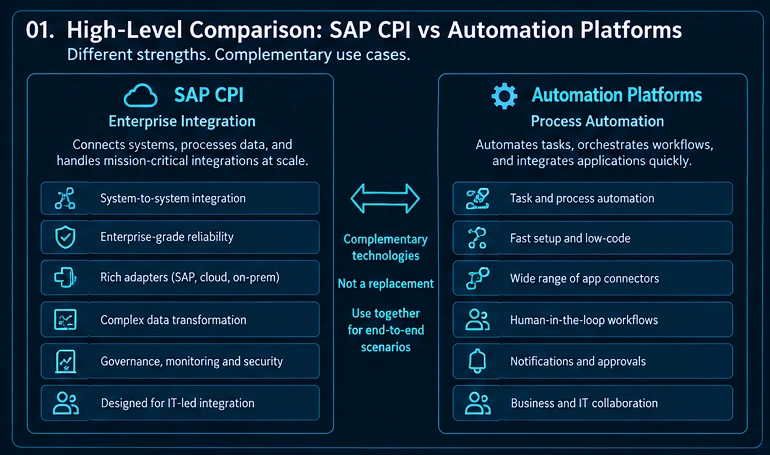
Where SAP CPI is strongest
SAP CPI is particularly strong when an organisation needs:
- SAP-to-SAP integration
- SAP-to-non-SAP integration
- Enterprise middleware governance
- Standard SAP adapters
- Structured message transformation
- Integration packages and transports
- Central SAP integration operations
It is a natural fit for SAP-centric environments.
Where automation platforms are strongest
Platforms such as n8n are highly effective for:
- API orchestration
- Event-driven workflows
- SaaS integration
- Webhook processing
- Operational automation
- Rapid prototyping
- Lightweight transformations
A process such as webhook → validate → transform → call API → notify can often be implemented very quickly and remain easy to understand visually.
The overlap
Both categories can call REST APIs, receive HTTP requests, transform payloads, route messages and handle authentication.
That overlap can make platform selection confusing. The difference becomes clearer when governance and operating context are considered.
SAP-centric integration
For a flow such as:
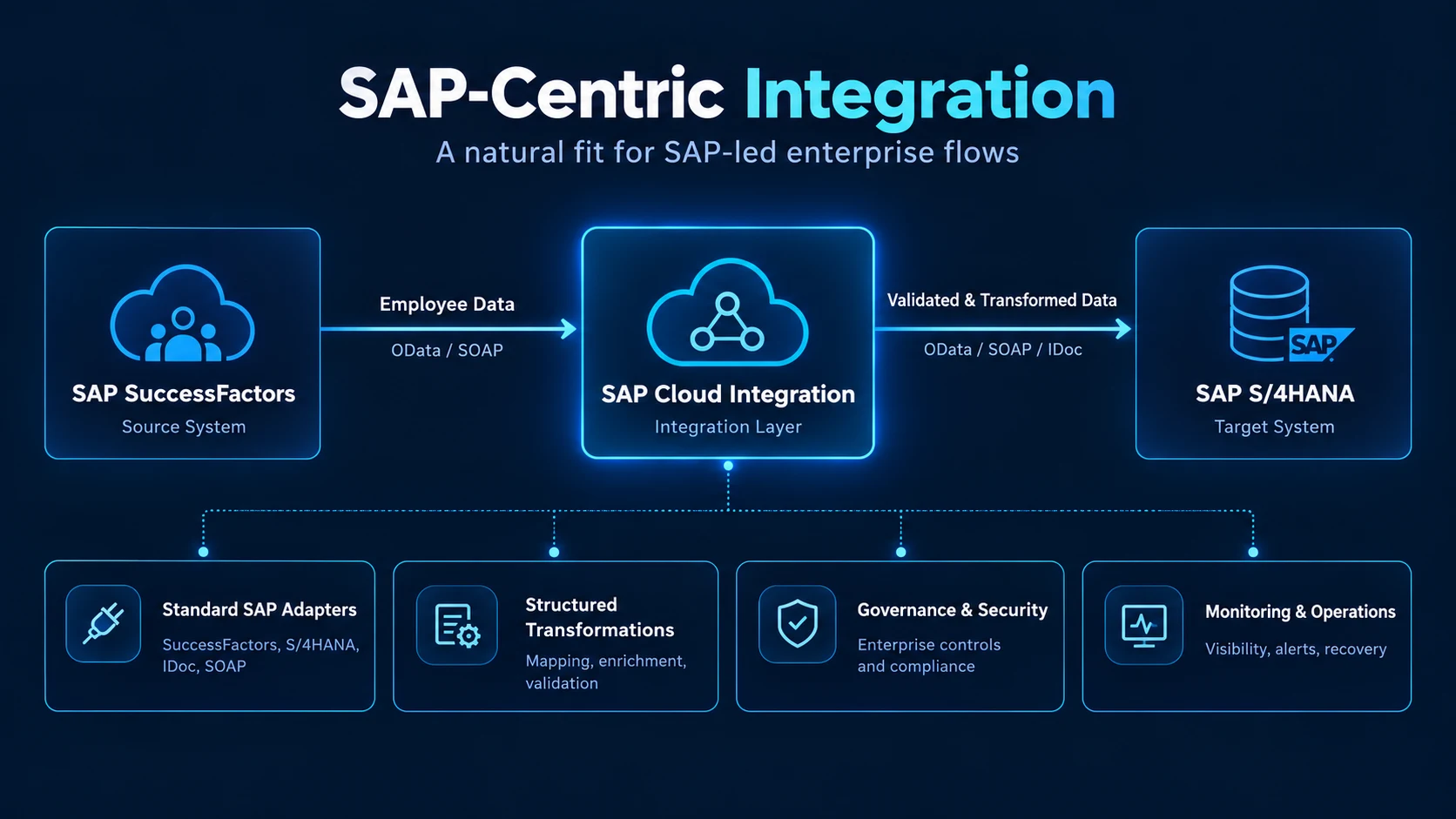
SAP CPI is usually the natural choice. It sits in the SAP integration landscape and supports patterns SAP teams already understand and operate.
SaaS workflow automation
For a flow such as:
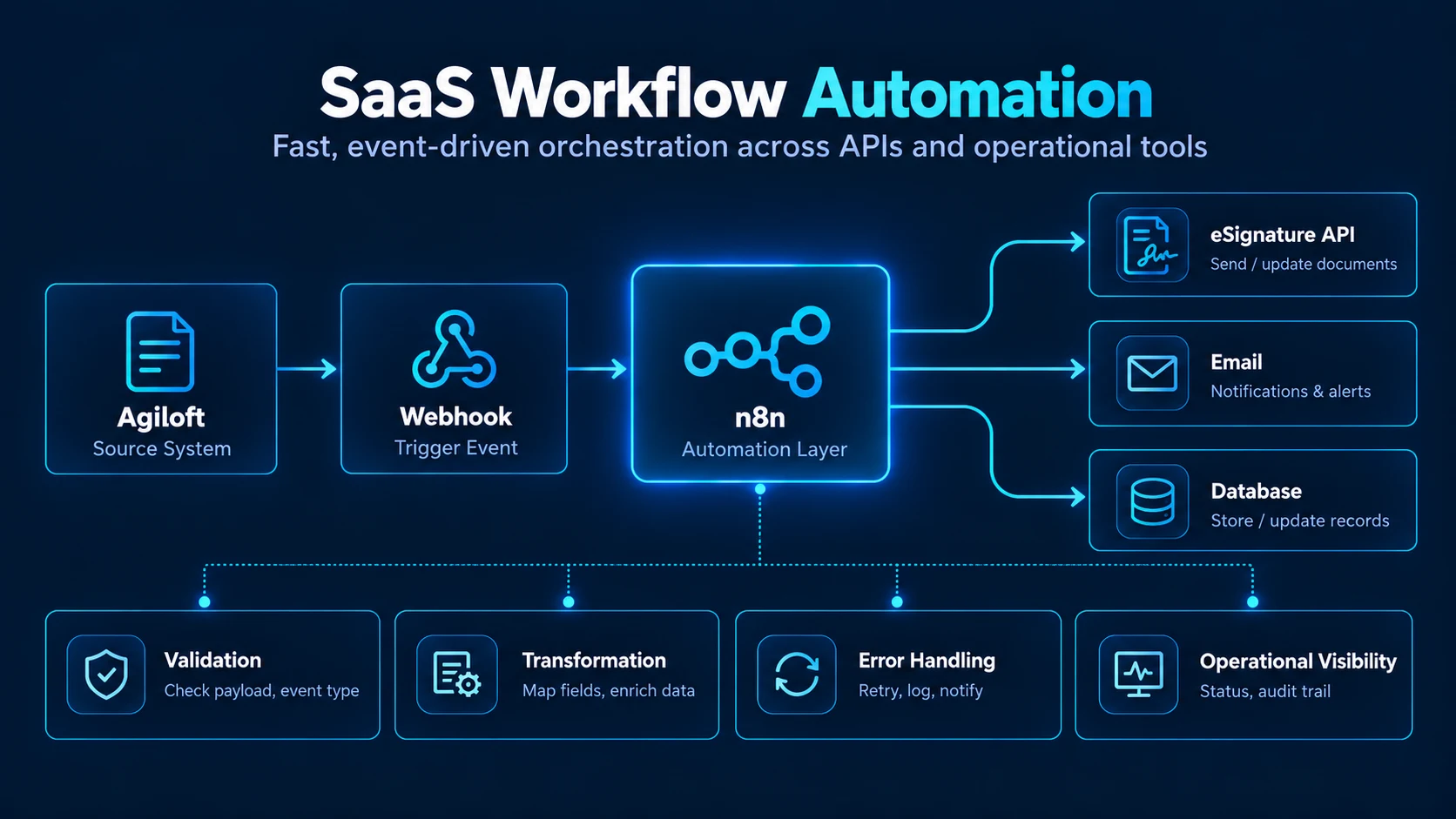
an automation platform may provide faster implementation and clearer operational visibility.
Using SAP middleware for this type of process may be unnecessary unless organisational standards require it.
Governance matters
Large enterprises may require formal transports, segregation of duties, central monitoring, controlled credentials, change approval and defined support models.
Those requirements can outweigh developer convenience.
The fastest tool is not always the correct enterprise platform.
Skill availability matters
Architecture should consider who will support the integration after go-live.
A technically elegant workflow becomes operationally expensive if only one person understands the platform.
Consider team capability, support ownership, licensing, documentation and escalation paths.
Transformation complexity
SAP CPI provides strong transformation capabilities through Message Mapping, XSLT, Groovy, XML and JSON processing.
Automation platforms can also transform data effectively, particularly JSON-centric API payloads.
If the integration heavily uses SAP-specific formats or complex XML, CPI may be more natural. For API-first JSON orchestration, an automation platform may be simpler.
Observability
Whatever platform is selected, the support team must be able to answer:
- Which transaction failed?
- Why did it fail?
- Is it retrying?
- Which source and target were involved?
- What is the correlation ID?
A production integration should not become a black box.
Cost is more than licensing
Total cost includes licensing, hosting, implementation effort, training, support effort, operational complexity and vendor dependency.
A cheaper platform can become expensive if the organisation has no support model for it.
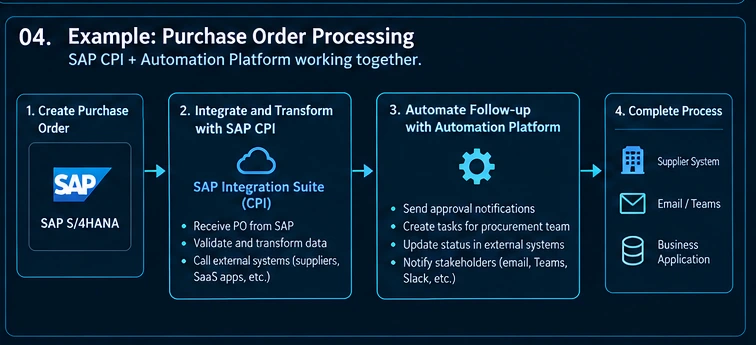
The hybrid model
Many organisations do not need to choose only one platform.
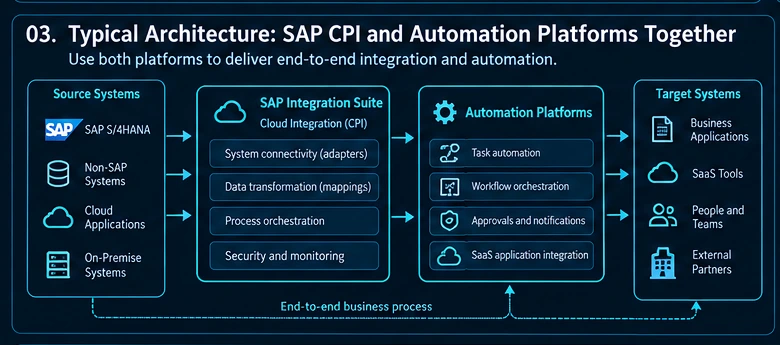
Each platform can handle the workloads that fit it best.
A practical decision framework
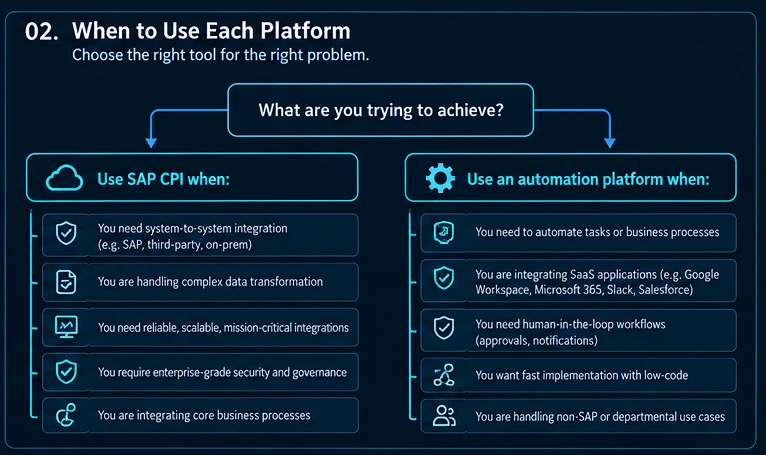
Use SAP CPI when SAP is central to the process, SAP adapters add value, enterprise middleware governance is required or existing support teams already operate CPI.
Consider an automation platform when the process is API-first, multiple SaaS products are involved, webhooks are central or the workflow is operational automation rather than core SAP middleware.
Consider a hybrid architecture when both SAP and non-SAP ecosystems are important.
Final thoughts
SAP CPI and modern automation platforms are not competitors in every scenario.

SAP CPI provides mature enterprise integration capabilities, especially in SAP-centric landscapes. Automation platforms provide speed and flexibility for API workflows, SaaS connectivity and event-driven processes.
The strongest architecture may use both, with clear governance defining where each belongs.